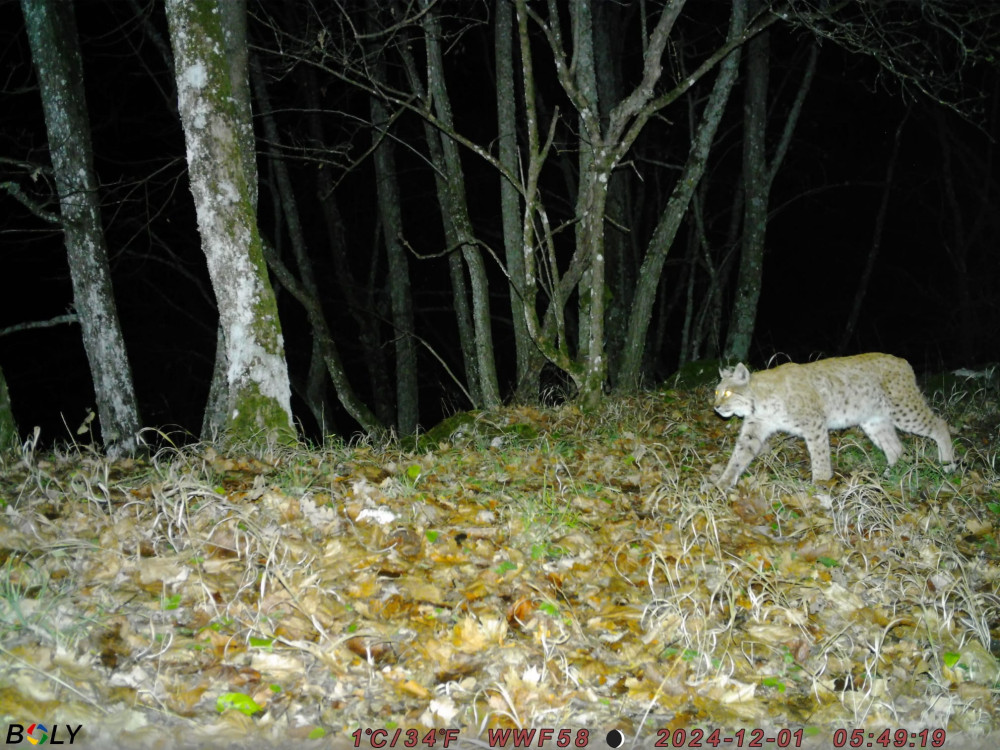
Footage from cameratrap
In the neighbouring Slovak Karst National Park, only two adult lynxes remain
Once naturally inhabited by Europe’s largest wild cat, the Slovak-Hungarian border region is now witnessing a dramatic decline in its Eurasian lynx population, with the species effectively disappearing from Hungary. Monitoring carried out by WWF-Slovakia and WWF-Hungary, in cooperation with partner organizations, confirmed the presence of only two adult lynxes in the Slovak Karst National Park, one of the species’ historic habitats in the region.
The scientific assessment has been carried out between spring 2023 and spring 2026 as part of the EU-co-funded project LECA, aiming to ensure harmonious coexistence between large carnivores and local communities in the Carpathian region. The findings are being highlighted by the environmental organisation ahead of International Lynx Day on 11 June, a day dedicated to raising awareness about lynx conservation.
“The current data suggest that the lynx population in the Slovak Karst area is on the very edge of survival,” warns Branislav Tám from WWF Slovakia, who has long been dedicated to the research of large carnivores. “If targeted measures are not taken, there is a real risk of its complete disappearance from the Slovak-Hungarian border region.”
The last confirmed lynx sighting on the Hungarian side of the border was recorded in 2025 in the Börzsöny Mountains. In the territory of Bükk National Park, the species' presence has not been confirmed since 2019, while in Aggtelek National Park no evidence of lynx has been detected since 2017. This clearly illustrates the alarming decline of the lynx population in this region.
“While we recorded mostly wolves and occasionally bears with our more than 100 trail cameras in the LECA project from 2023 to 2025, we didn’t find any signs that would indicate the presence of the lynx in the Bükk-Aggtelek region. Besides an old male individual which was observed in 2025 for last time in the Börzsöny Mountains and might be dead for now, we have no current knowledge about the lynx in Hungary. Based on this, we can assume that the species has basically disappeared from Hungary. Further monitoring activities and cross border cooperation are essential to know more about the reasons behind this decline and to secure the long-term survival of the species in the region and its return to Hungary”, adds Dávid Sütő, large carnivore expert at WWF-Hungary.
Two of the main threats for a thriving Eurasian lynx population in Central and Eastern Europe continue to be poaching and habitat fragmentation. Despite legal protection, Eurasian lynx is still illegally shot in several countries. In Slovakia and Ukraine, WWF and partners have reported continued poaching. In Bulgaria, historic persecution contributed to the species’ disappearance as a breeding population. Infrastructure development, that does not sufficiently consider ecological connectivity, disrupts lynx movement and separates small populations. This reduces genetic exchange and hinders them from returning to areas where the species once freely roamed.
The alarming state of the population in this ecologically significant region signals a need for cross-border cooperation. “Large carnivores do not recognize borders. If we want to protect them effectively, we must cooperate and share knowledge across the entire Carpathian region,” emphasizes Martin Duľa, LECA project coordinator from Mendel University in Brno.
The need for cooperation is also reflected in neighbouring Ukraine, where monitoring in Uzhanskyi National Nature Park confirmed the presence of seven individual Eurasian lynxes. Researchers have repeatedly recorded one particularly adventurous male moving between Ukraine and Slovakia, demonstrating that effective lynx conservation depends on transboundary cooperation and connected habitats across the Carpathians.
The lynx assessment was conducted within a wider monitoring programme focused on large carnivores in the Carpathians. As part of the project, experts used modern monitoring methods such as camera traps, genetic analyses, and GPS telemetry. More than 560 camera traps were deployed across an area exceeding 37,000 km², 108 individual animals were identified, and 27 of them were equipped with telemetry collars. The collected data provide valuable insights into the movement, behaviour, and territories of large carnivores.
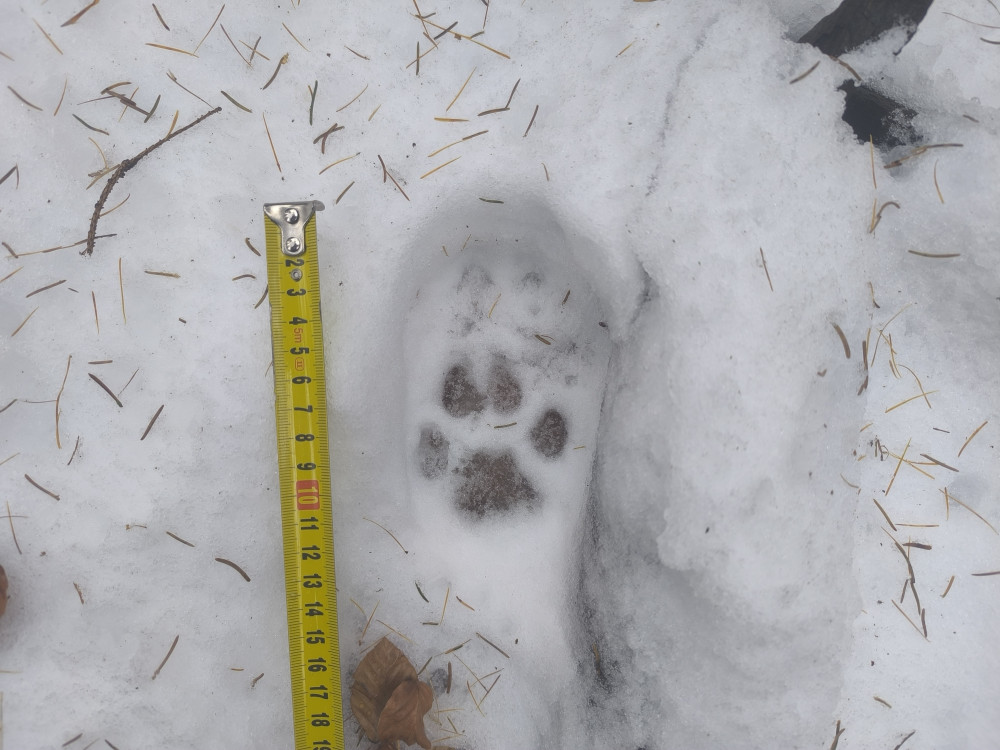
Lynx footprint